

What diaper insecurity looks like in South Carolina
Lower-income parents often do a dark kind of calculus: Change their baby’s diaper, or risk running out. It’s a kind of equation that usually goes unnoticed.
By Scott Morgan, Managing Editor,
Oct. 18, 2025
It’s Cupcake Day. It’s too sunny, too cool, too perfect a Friday to be anything else.
Ms. Pringle is waiting to bake them and take them with her to the park when her children get out of school, just a couple hours from now.
But for the next hour, give or take, she tips forward in her seat, quiet and succinct, tightened into a ball too uncomfortable to uncoil. She’s here, mostly, for the diapers. She’ll get 200 of them just for talking to me. An incentive from this diaper bank in Columbia to encourage the telling of her story.
It’s an uneasy capitalism that drives diaper insecurity. Diapers are a commodity that’s always in need. Retailers and manufacturers rarely discount the way food and cheap clothing get discounted; and yet they’re usually handled as an incentive. Come to a self-betterment workshop. Take a class. Learn to be better at parenting. We’ll give you diapers for your for your efforts.
This rankles Ayanna White, who founded this diaper bank a decade ago. Even as she offered a supplemental supply of diapers to moms who come to Power In Changing, in exchange for helping to get spread the word that diaper insecurity is a really serious, really invisible thing.
An Inadequate Overview of Diaper Insecurity in South Carolina
On Sept. 8, Urban Institute, a Washington, D.C.,-based think tank, released a county-by-county map showing where diaper insecurity — the lack of reliable access to fresh diapers — in the U.S. was most dire.
Urban Institute’s data show that to supply “all families with young children and low-to-moderate incomes” in South Carolina with enough diapers “to keep their children dry,” would take 84. 6 million of them.
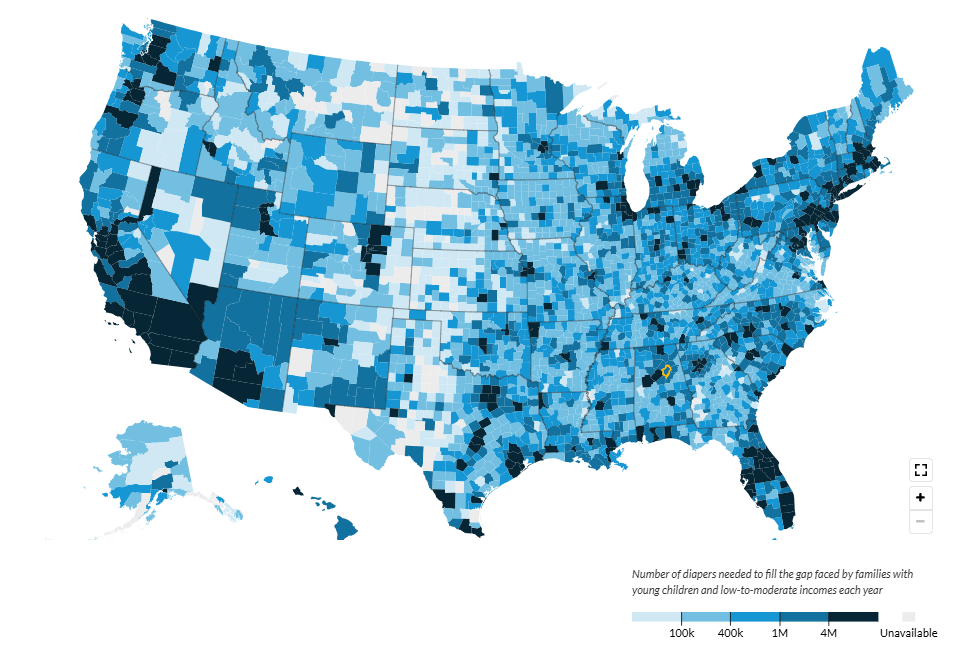
In seven counties — one in every six-and-a-half in the state — diaper shortage is at least 4 million; in nearly half of the state’s counties, it is at least 1 million.
Richland is the state’s second-most diaper-indebted county. With a diaper debt of 6.9 million, it trails only Greenville County’s shortfall of 8.8 million diapers.
Twenty-eight counties, nearly two in three, are in diaper bank desserts, meaning zero residents have reasonable access to a diaper bank.
Of the 11 counties that border North Carolina, two –York and Lancaster — have at least one basic needs/diaper bank in their service areas. These 11 counties have a diaper shortfall of almost 31 million.
Conversely, of the 15 North Carolina counties that border South Carolina, two — Scotland and Anson — do not have a diaper bank within reasonable reach of residents. But just as North Carolina has about twice the population of South Carolina, it also has about twice the overall diaper debt.
It’s 200 Diapers Bad
The walk from Power In Changing’s office, across a choppy parking lot, to a lofty warehouse space takes less than two minutes. We walk under a ladder propped up close to the back steps, and Ayanna White and I both feel we’re courting bad luck.
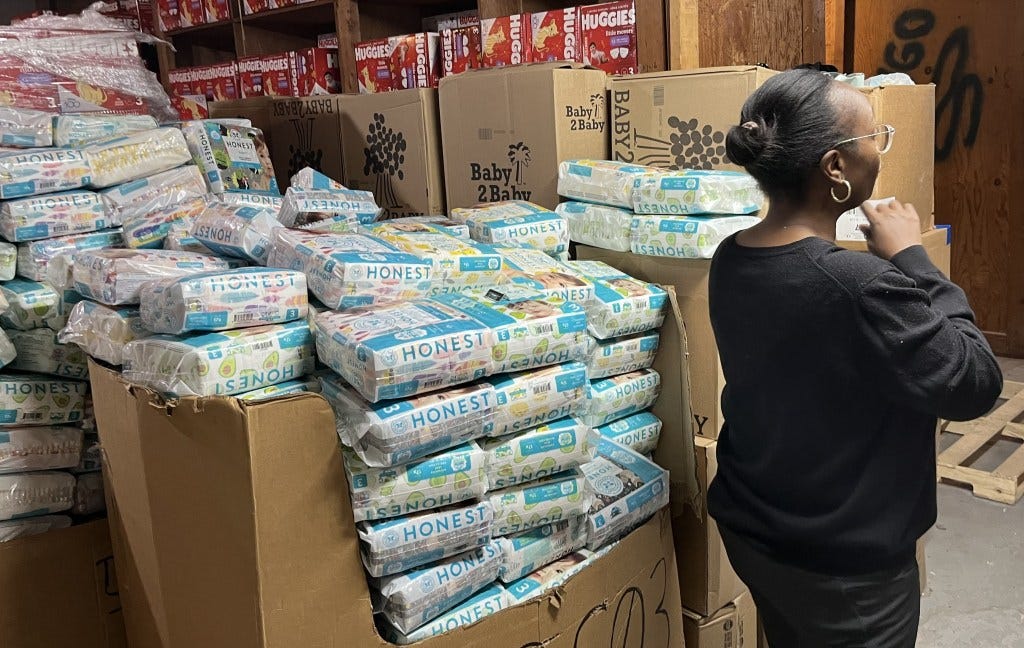
White leads me through a maze of rooms piled high with period products, incontinence supplies, and diapers. The boxes make ad-hoc hallways through what used to be a grocery store. The buildings in this shopping center off Two Notch Road in Columbia date back to the 1960s. The wood and masonry are aromatic with age. The place feels dusty, in the way old buildings do without having any dust at all.
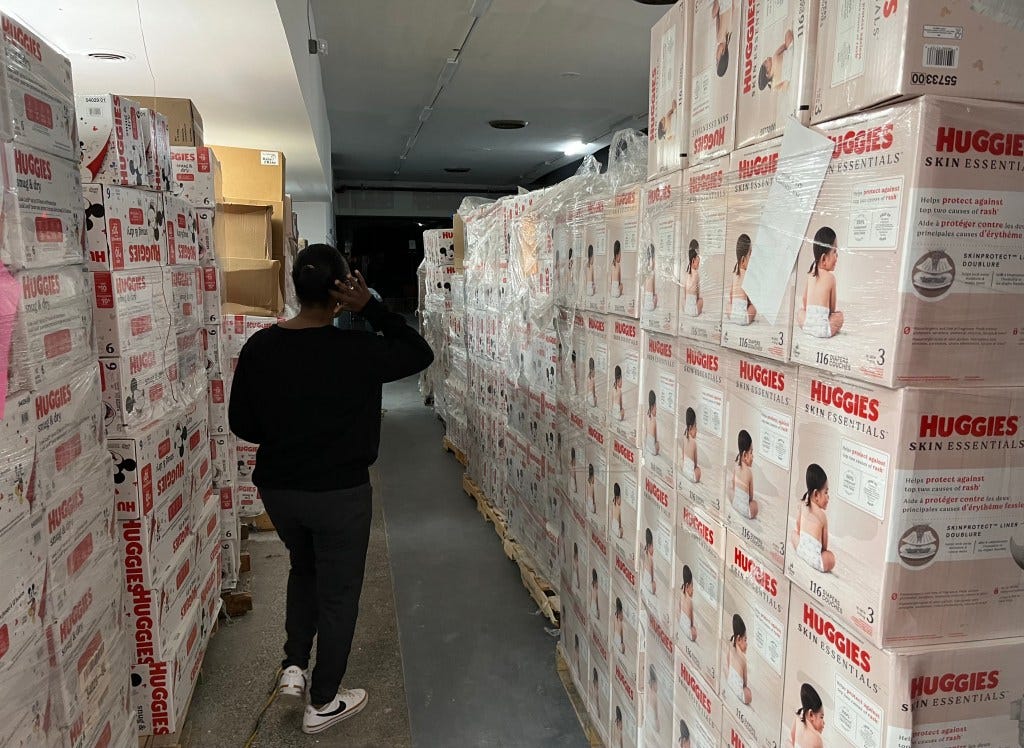
A corridor of Huggies diapers, one of Power In Changning’s national partners towers over us on two sides. White tries to keep 6,000 diapers of each size, up to 6, on hand at all times. Most are kept in this otherspace. She stops at size 6 to encourage potty training.
Our conversation drifts to Ms. Pringle, who patiently waits for us across the parking lot, dreaming of cupcakes. White wasn’t expecting her to show to talk to me at all, much less show 40 minutes before 11 in the morning.
But when she asked if any of her clients would like to speak with a reporter, White offered some extra supplies, in hopes it would get a few moms to share their stories and help explain how dire the need for diapers in the capital region is. Three moms showed. Ms. Pringle showed first.
“ She’s not getting cash or a gift card or anything, she’s getting diapers,” White says. “So to show up early and eager to talk in the hopes of getting up to 200 diapers, which is a box, that’s how serious it is. I mean, it’s really bad out here.”
‘I Was Going to Commit, Essentially, Bank Fraud
‘Just to get the essentials for my family.”
She didn’t. It’s funny like a bad joke to her now.
But White had spiraled so far out of control 11 years ago that this was where she landed — considering bouncing a check and shouldering the overdraft charge from her bank, just to buy a pack of diapers and some gas for the car.
White’s mother, who’s cleaning the windows of Power In Changing’s storefront when I walk in, preempted her daughter’s crime streak by giving her the $50 she needed for diapers
Desperation had propelled White to consider a rash move. Her toddler, now 11, had used up her last diaper on a Wednesday. White didn’t get paid until Friday. and she was financially, almost entirely, tapped.
“I had a silent spiral,” White says. “I can’t properly take care of my child. What does this mean? Does this mean that CPS (Child Protective Services) is gonna be called because I don’t have the resources? Does it mean that I’m gonna be looked down upon on or shamed just because I don’t have the proper resources to take care of my child? That’s heavy.”
It’s also not abstract. Studies, like this one published in the New England Journal of Medicine in September, which finds connections between diaper need and drivers of social health; and this one published in the Journal of Pediatrics in 2020, linking diaper dermatitis — rash — to increased visits to pediatric facilities for urinary tract infections; and this article published by the American Academy of Pediatrics in September, showing the correlation between diaper need and caregiver stress, lay bare how complex and nuanced the issue of diaper need is.
“We do know diaper need can lead to abuse and neglect,” White says. “We’ve had reports of neglect … where they’re just leaving the child in the diaper because they just don’t have anything else. Or having the child just run around naked, which is all fine if you’re at home. But if you’re a working mom or a mom in school, daycare needs those items. Whoever you’re leaving your child with would need those items to be properly taken care of. So there’s a lot that goes with a very basic item.”
Have You Ever Seen a Coupon for Half-off Diapers?
Ms. Taylor has had to make a bad kind of calculus.
“I’m not gonna lie,” she says. “I did have to let the diaper sit when I didn’t have enough.”
Ms. Taylor is 28. She was a nurse assistant before she injured her back and neck on the job. Eventually it cost her the job. She met a guy, with whom “ it went well until it didn’t,” and got pregnant. He wanted nothing to do with the baby.
Back living with her mother, her bills piled high. She lost her car. And then, one day, she found herself checking the amount of pee in her daughter’s diaper to see how for how long she could leave it on. Because she was running to low to risk changing it too soon.
“I learned to make sure [to] clean her really good, make sure she’s dry and I put some cream on her,” she says.
It doesn’t sit well with her.
“I feel like, you’re making your baby suffer,” she says. “You don’t want them to suffer.”
Ms. Taylor and her mother deliver DoorDash meals to help make ends meet. With some things, the things that go on sale, the money helps. With diapers, not so much.
“Why do diapers have to be so expensive for us to get?” she asks. “Why isn’t it on a discount? Why you don’t see that with coupons? Because I haven’t received no coupons in my diapers, but I would love some.”
Food items, she says, occasionally get steeply discounted. Buy-one-get-one-free translates to half-off. She says she’s yet to see that kind of deal be offered for diapers, and the two other mothers in this room — Ms. Pringle and Ms. Sade, like the singer — nod energetically when she does.
“I feel like that’s something that should change,” Ms. Taylor says. “And it shouldn’t be for a long period of time, but just like with food, you’re able to have these different little gigs, little promos, where you’re able to get certain stuff on a deal. I feel like they should be able to have a deal with the diapers, the wipes, clothes. That would be lovely.”
A flurry of reports by research firms, not all of them backed up by hard evidence, come up in any online search for the size of the global diaper market. They vary wildly in how they see the market growing over the coming five to ten years. But they all agree that the current diaper market is worth more than $50 billion in 2025, and that it will grow by at least $10 billion by 2030.
There is No SNAP for Diapers
Arguably, the loveliest lady in the room is Eva, who munches cookie bits and occasionally slides down her mother’s lap. Eva just turned 1 a couple days ago. She’s about to move up a size in diapers.
Her mom is Ms. Sade, whose T-shirt champions not the singer with whom she shares a name, but rather The Miseducation of Lauryn Hill.
Ms. Sade is unwell. She doesn’t work because she battles a lung disease and thyroid cancer, with a mutation that makes an already aggressive cancer more aggressive.
“Trying to work and having chronic headaches and feeling like I’m gonna pass out,” she says, “[the doctors] were like, ‘You really have to sit this one out, you have to relax and rest.’ And it’s like, how do you take care of a family and you’re asking me to relax? It was just a very tough place to be.”
Like Ms. Taylor and Ms. Pringle, Ms. Sade is here in part to get some extra supplies for talking with me, and in part to try to explain how crippling diaper insecurity can be.
“ I have a 13-year-old daughter and the same $40 case [of diapers] was $20 back then,” she says. “You see that price and you’re like, they were never this high.”
According to the National Diaper Bank Network, or NDBN, diapers cost families between $80 and $100 per month, on average in South Carolina. And unlike programs such as the Supplemental Nutrition Assistance Program (SNAP), which provides money towards food for (increasingly fewer) lower-income households, diapers have no direct conduit to a program to help pay for them.
TANF dollars (Temporary Assistance for Needy Families) can be used to purchase diapers. But generally, TANF assistance goes towards expenses like heat, utilities, rent, clothes, transportation, and other day-to-day costs.
“Little if any (TANF) money is available to purchase enough diapers to keep a baby clean, dry, and healthy,” states NDBN’s July report on South Carolina.
Diaper Assistance and the State
Power In Changing started in 2015 when Ayanna White realized she had no diaper resource to turn to, and that she was hardly alone. The diaper bank grew fast, and White pretty quickly realized that there is more than diaper insecurity for families in diaper need to contend with. There are also “ clothing insecurity, bottle insecurity,” White says. “You know, just feeding mechanism for their children.”
The state government does not fund diaper banks. White says her annual monthly budget to keep Power In Changing going is $10,000 or more.
There is a state House bill, currently in the House Ways and Means Committee, heading into the second half of the South Carolina Legislature’s current two-year cycle that would remove sales tax from diapers. But there is no other state legislation looking to address diaper assistance, nor are there funding mechanism for diapers beyond occasional emergency disaster relief and any existing state or federal government resources that help fund supplies certain conditions or disabilities, such as autism.
This is why Ms. Pringle relies so much on this diaper bank.
“When I came here, they gave me a good supply of diapers,” she says. “I was down to my lowest and I had nothing. So I came here and they helped me a lot. And I got better changing diapers. No more diaper rashes or nothing like that.”
Ms. Pringle is 30 and a mother of three. She’s come here over the past three or so years. Power In Changing is close enough for her to walk to, which is convenient only because she has no car.
I ask her if needing help with a basic item like diapers affects her perception of herself as a mom.
“ It just makes me more stronger to ask for help,” she answers. “Even though I know I don’t have any family here to help me. So coming here has helped me a lot. And it has encouraged me. It don’t bring me down. It makes me happy. I’m very excited for their help.”
Ms. Sade and Ms. Taylor largely say the same thing. Ms. Taylor, in fact, has such gratitude for this diaper bank, she wants her next career move to be something just like it.
If you wish to do something similar, know that it is a monumental task. White says Power In Changing serves 400 families a month and needs between $10,000 and $12,000 to do so. You will likely get yelled at by frustrated parents. Seen as a repository of diapers and supplies by Social Services workers who remove children from troubled homes. And ever trying to correct the view that diapers are something to use as a reward for showing up to parenting classes. White is aware of the irony of trading diapers (and a stroller) for getting three moms into this room to speak with me. She considers it fair compensation for their time, for existing clients.
But she knows that as long as diapers are seen as a reward, the larger point will be missed.
“Parents really, really needs these items,” she says. “We can see a tangible effect. We know that you’re gonna change the child’s diaper more if you have these items. We know that there’s going to be less instances of severe diaper rash or urinary tract infections by handing over these items to a family that needs it.”
As we wrap our conversation, Ms. Pringle, Ms. Taylor, and Ms. Sade say they look forward to spending the day in the park with their children. It’s something else they all share in common, a kind of peace that comes with being outside in the sun, with their kids.
Ms. Pringle is heading home to bake the cupcakes first. It’s nobody’s birthday. It’s no special occasion, she says. It’s something she can do for her children.